Contrastive Discrepancy: A label-free metric for deformable image registration supporting testing-time hyperparameter selection
Sep 1, 2026·
 ,
,
,
,
,
,
,
·
0 min read
,
,
,
,
,
,
,
·
0 min read
Xia Li
Jihe Li
Weijie Wang
Xiang Liu
Jiquan Yuan
Xixin Cao
Joachim M. Buhmann
Jianqi Sun
Abstract
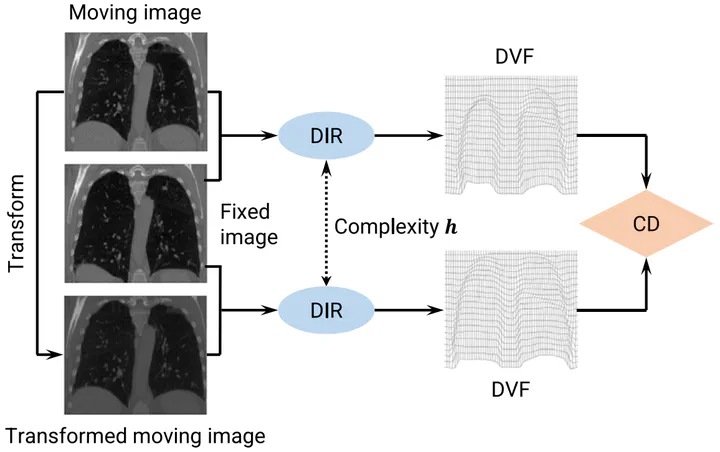
Deformable image registration (DIR) proves critical to many medical image analysis tasks, yet its reliable evaluation is fundamentally challenged by the absence of ground-truth deformations. Existing label-based metrics require costly manual annotations, while current label-free alternatives often fail to capture anatomical correspondence. To address this dilemma, we introduce Contrastive Discrepancy (CD), a novel label-free metric for robust evaluation and automatic hyperparameter tuning without requiring manual annotations in DIR. Grounded in bias–variance trade-off theory and group equivariance, CD quantifies model performance by measuring the discrepancy between deformation vector fields (DVFs) produced when registering a fixed image with different observations of the moving image sampled from the same anatomical orbit under a transformation group, such as an affine group. This approach penalizes both underfitting models, which exhibit high bias, and overfitting models, which are sensitive to unstructured perturbations and thus have high variance. Through extensive experiments across three DIR model families and two public datasets, we demonstrate that CD’s performance curve consistently mirrors that of the gold-standard Target Registration Error (TRE) and substantially outperforms existing label-free metrics. Crucially, the validated reliability of CD unlocks its most significant application: fully automatic, testing-time hyperparameter selection. This hyperparameter learning enables DIR models to be dynamically optimized for individual patient data without any labeling cost. By offering a practical pathway to automated model tuning, Contrastive Discrepancy bridges the gap between advanced DIR methodologies and their precise, personalized application in clinical workflows.
Type
Publication
Medical Image Analysis