Comparative evaluation of static and dynamic 4D dose recalculations in pencil beam scanning proton therapy for oesophageal cancer
Jan 1, 2026·
,
 ,
,
·
0 min read
,
,
·
0 min read
Linus A. Carizzoni
Alexey Cherchik
Xia Li
Antony J. Lomax
Ye Zhang
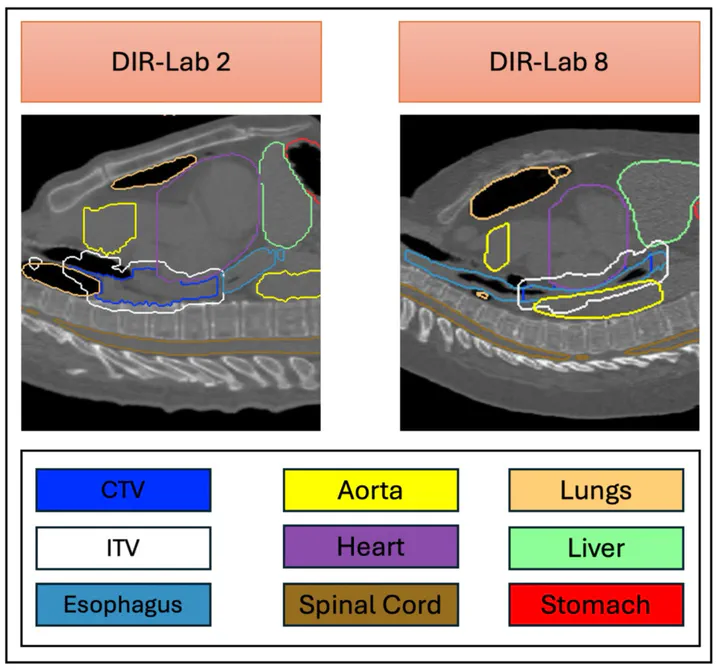 Image credit:
Abstract
The robustness of pencil beam scanned (PBS) proton plans to respiratory motion is often assessed in clinical practice by static 4D dose recalculations on selected 4D computed tomography (4DCT) phases. These capture anatomical variation but neglect interplay effects from sequential beam delivery. This study investigates these effects by comparing static and dynamic 4DDC for esophageal cancer patients.
Type
Publication
Physics and Imaging in Radiation Oncology