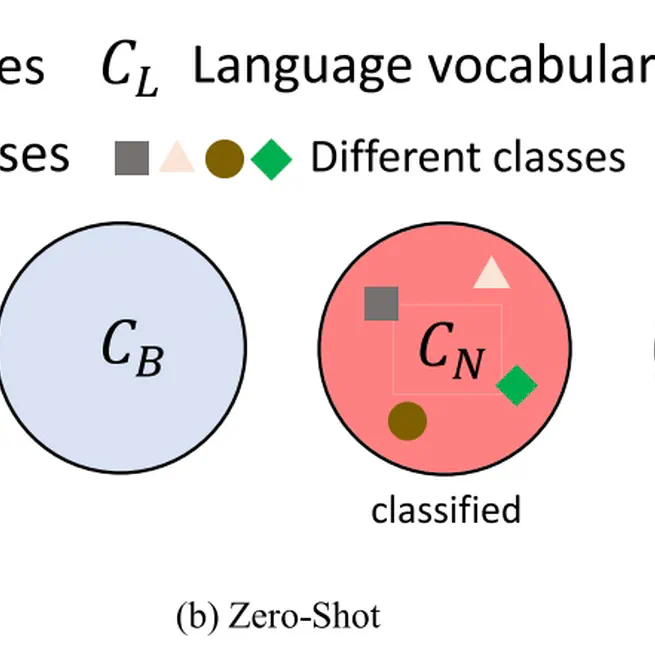
Towards open vocabulary learning: A survey
This survey offers a detailed examination of the latest developments in open vocabulary learning in computer vision, which appears to be a first of its kind. We provide an overview of the necessary background knowledge, which includes fundamental concepts and introductory knowledge of detection, segmentation, and vision language pre-training. Following that, we summarize more than 50 different models used for various scene understanding tasks. For each task, we categorize the methods based on their technical viewpoint. Additionally, we provide information regarding several closely related domains. In the experiment section, we provide a detailed description of the settings and compare results fairly. Finally, we summarize several challenges and also point out several future research directions for open vocabulary learning.
Feb 5, 2024
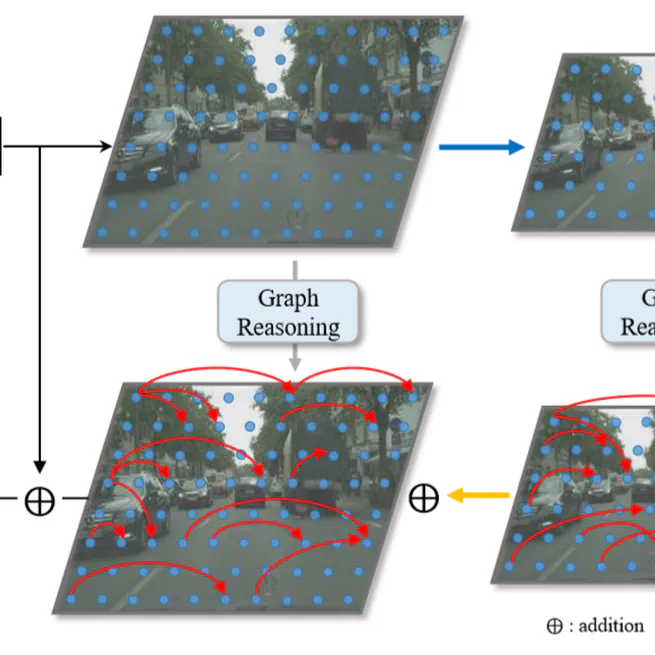
Spatial Pyramid Based Graph Reasoning for Semantic Segmentation
Feb 24, 2020
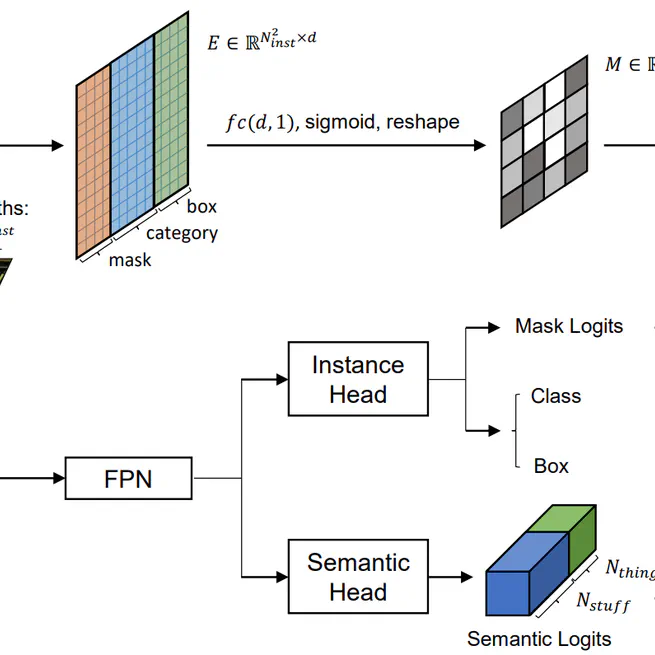
SOGNet: Scene Overlap Graph Network for Panoptic Segmentation
We leverage each object’s category, geometry and appearance features to perform relational embedding, and output a relation matrix that encodes overlap relations. In order to overcome the lack of supervision, we introduce a differentiable module to resolve the overlap between any pair of instances.
Feb 7, 2020

Dynamic System Inspired Adaptive Time Stepping Controller for Residual Networks Families
We analyze the effects of time stepping on the Euler method and ResNets. We establish a stability condition for ResNets with step sizes and weight parameters, and point out the effects of step sizes on the stability and performance. Inspired by our analyses, we develop an adaptive time stepping controller that is dependent on the parameters of the current step, and aware of previous steps.
Feb 7, 2020
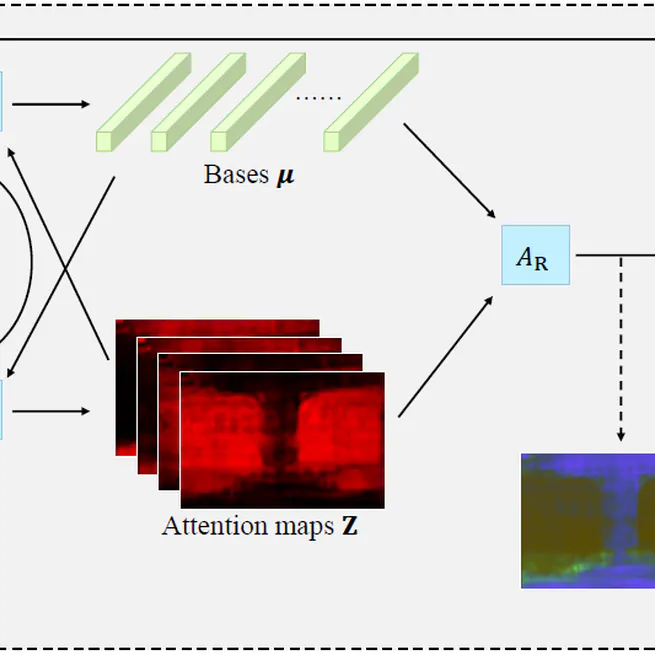
Expectation Maximization Attention Networks for Semantic Segmentation
We formulate the attention mechanism into an expectation-maximization manner and iteratively estimate a much more compact set of bases upon which the attention maps are computed.
Jul 22, 2019