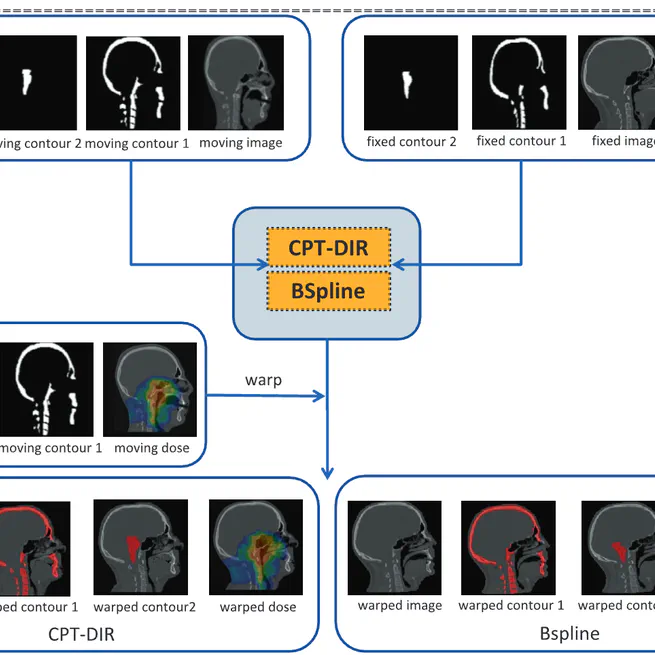
Contour-informed inter-patient deformable registration for more reliable voxel-based analysis of Head-and-Neck cancer patients
The integration of contour-informed regularization in CPT-DIR improved DIR accuracy, particularly in anatomically and dosimetrically relevant regions.
Jan 1, 2026
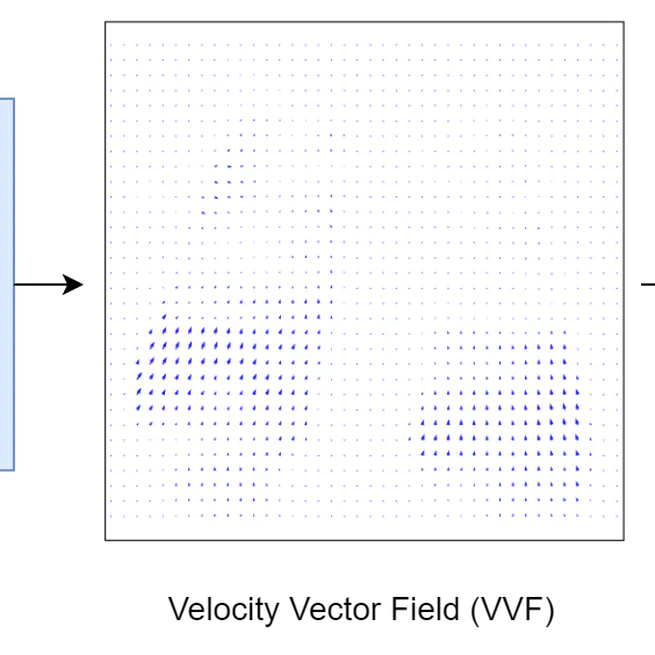
Continuous sPatial-Temporal Deformable Image Registration (CPT-DIR) for motion modelling in radiotherapy: beyond classic voxel-based methods
By leveraging the continuous representations, the CPT-DIR method enhances registration and interpolation accuracy, automation, and speed.
Dec 26, 2025
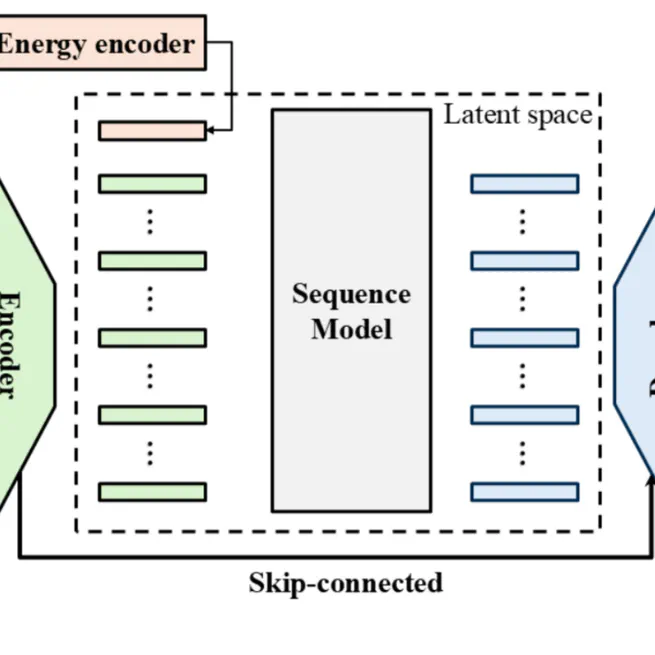
A proof-of-concept study of direct magnetic resonance imaging-based proton dose calculation for brain tumors via neural networks with Monte Carlo-comparable accuracy
This study demonstrated the feasibility of MC-quality proton dose calculations directly from MR images for brain tumor patients, achieving comparable accuracy with faster computation and simplified implementation.
Jul 5, 2025
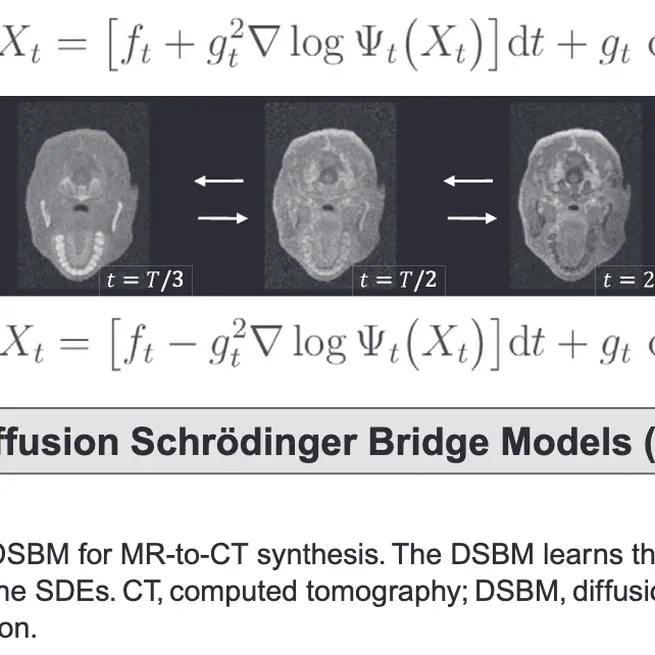
Diffusion Schrödinger bridge models for high-quality MR-to-CT synthesis for proton treatment planning
A diffusion Schrödinger bridge model for high-quality MR-to-CT synthesis for proton treatment planning.
Jan 1, 2025
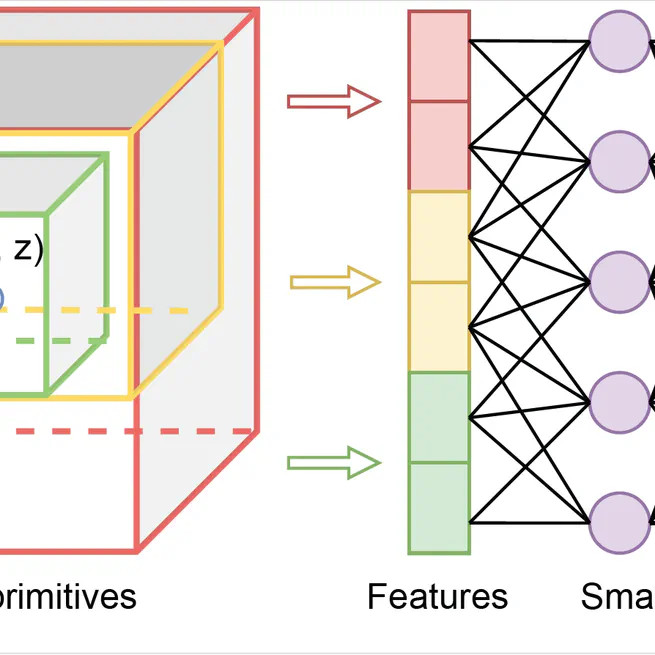
Neural Graphics Primitives-based Deformable Image Registration for On-the-fly Motion Extraction
In this study, we have successfully integrated NGP into DIR, a novel contribution that significantly enhances the accuracy and efficiency of medical image alignment as demonstrated on the DIR-lab dataset. The NGPDIR framework exhibits robust performance across various metrics, particularly in landmark alignment precision and the accommodation of anatomical sliding boundaries. This advancement not only propels the DIR field forward but also opens new avenues for real-time clinical applications, potentially transforming patient care with its rapid, reliable imaging capabilities.
Jul 8, 2024